Projects

Research code, open-source tools, and academic resources.

Research Code

GradSCF

A Python framework for molecular and periodic electronic-structure calculations, differentiable numerical methods, and machine-learned models.

A JAX framework where electronic-structure methods, their responses, and learned models are differentiated end to end.

Python MIT license ★ 3 Updated Oct 2026
differentiable-programmingelectronic-structuremachine-learningquantum-chemistry
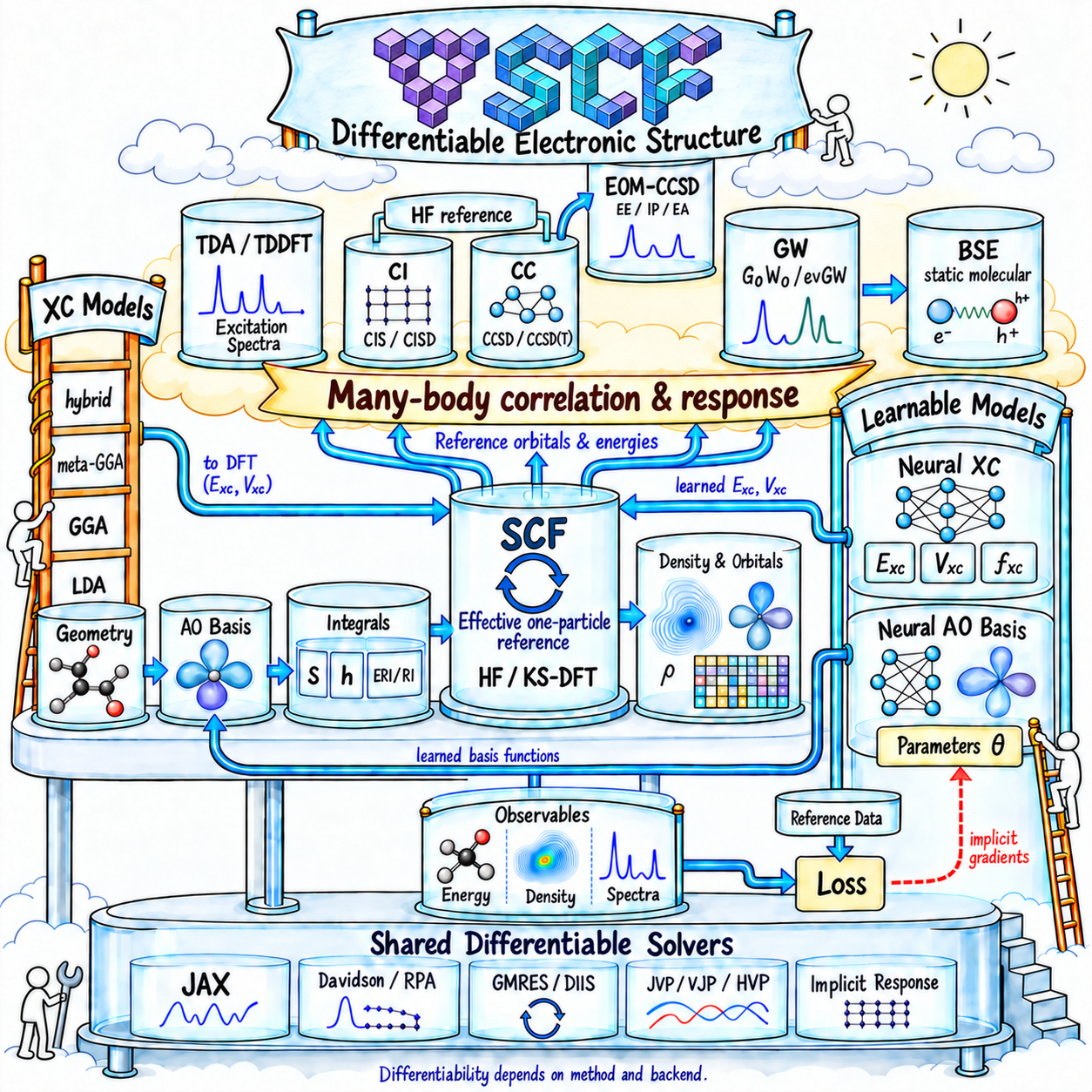
Framework overview: from geometry to response and learned models
Features, implementation & modules

Key features

  • Molecular and periodic HF, DFT, MP, CI/FCI, CC and EOM-CCSD.
  • TDHF/TDDFT, GW and BSE spectra through shared implicit response.
  • External XC or neural-basis models plugged into the SCF loop.

Implementation

JAX kernels with a bundled libcint integral backend; converged states are differentiated through fixed-point response rather than unrolled iterations.

Modules

  • gto · scf · dftgeometry, basis sets, HF and KS-DFT references
  • mp · ci · ccpost-HF correlation through EOM-CCSD
  • tdscf · gw · bseresponse, quasiparticles, optical spectra
  • integrals · modellibcint backend and XC training drivers
GradTDDFT

JAX research toolkit for differentiable TDDFT: strict-JAX SCF, TDA/Casida TDDFT, Neural Network XC/RSH training, spectra, integrals, and CUDA J/K experiments.

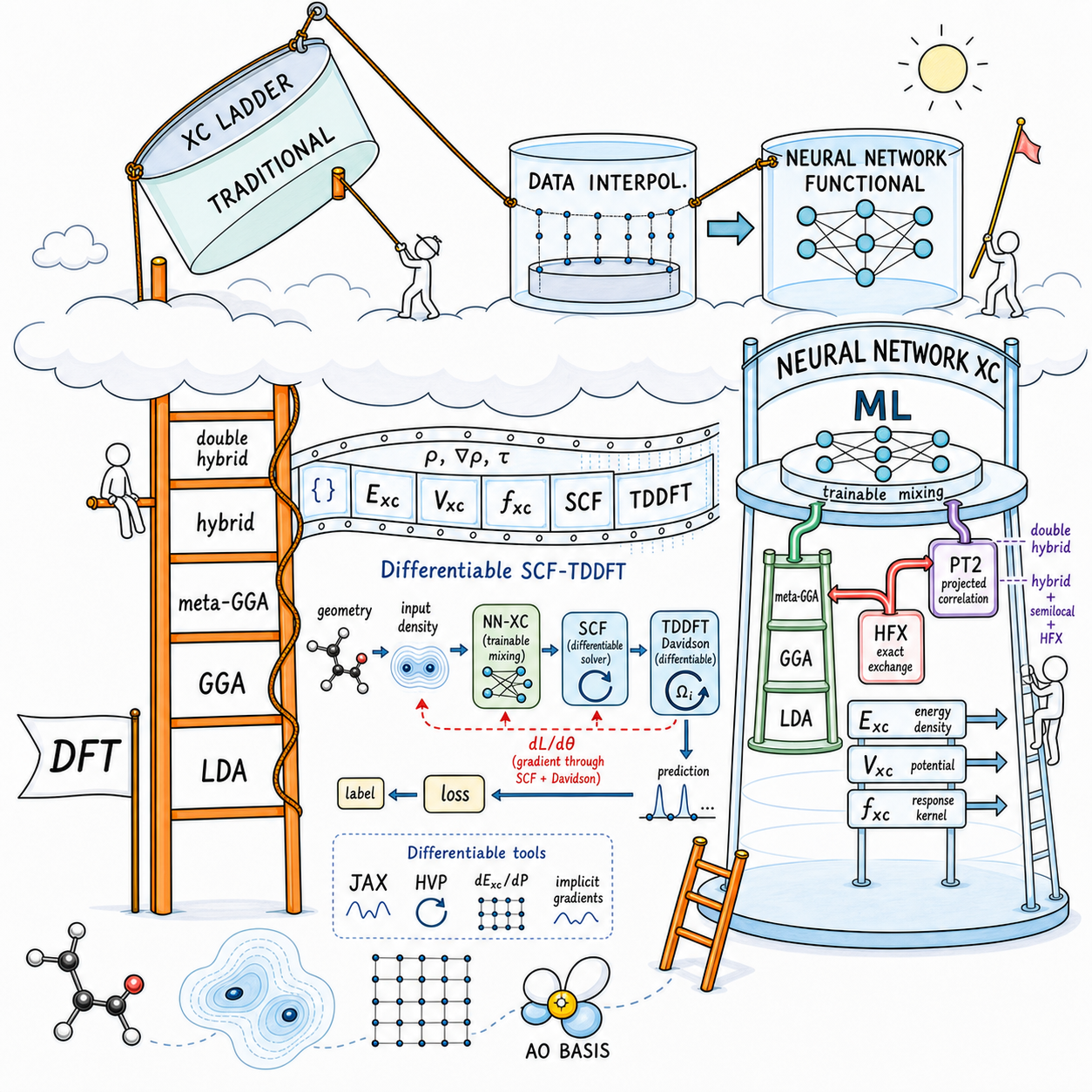
The differentiable SCF → TDDFT → neural-XC pipeline behind the GradTDDFT manuscript.

Python MIT license ★ 7 Updated Oct 2026
deep-learningdifferentiable-programmingquantum-chemistry-programs
Neural-XC TOC graphic from the GradTDDFT manuscript
Features, implementation & modules

Key features

  • JAX SCF with explicit and implicit differentiation modes.
  • Matrix-free TDA and full Casida TDDFT with Davidson solvers.
  • Residual neural-XC models trained through the response equations.

Implementation

JAX kernels with an optional PySCF integral backend; neural functionals are trained by backpropagating through converged response.

Modules

  • dft · scfreferences and differentiation modes
  • tdscfTDA and Casida solvers
  • neural_xc · neural_dfunctional models and backbones
  • trainingtraining and evaluation drivers

Development has moved to GradSCF; this repository remains the v1.0.0 reference.

QHformer

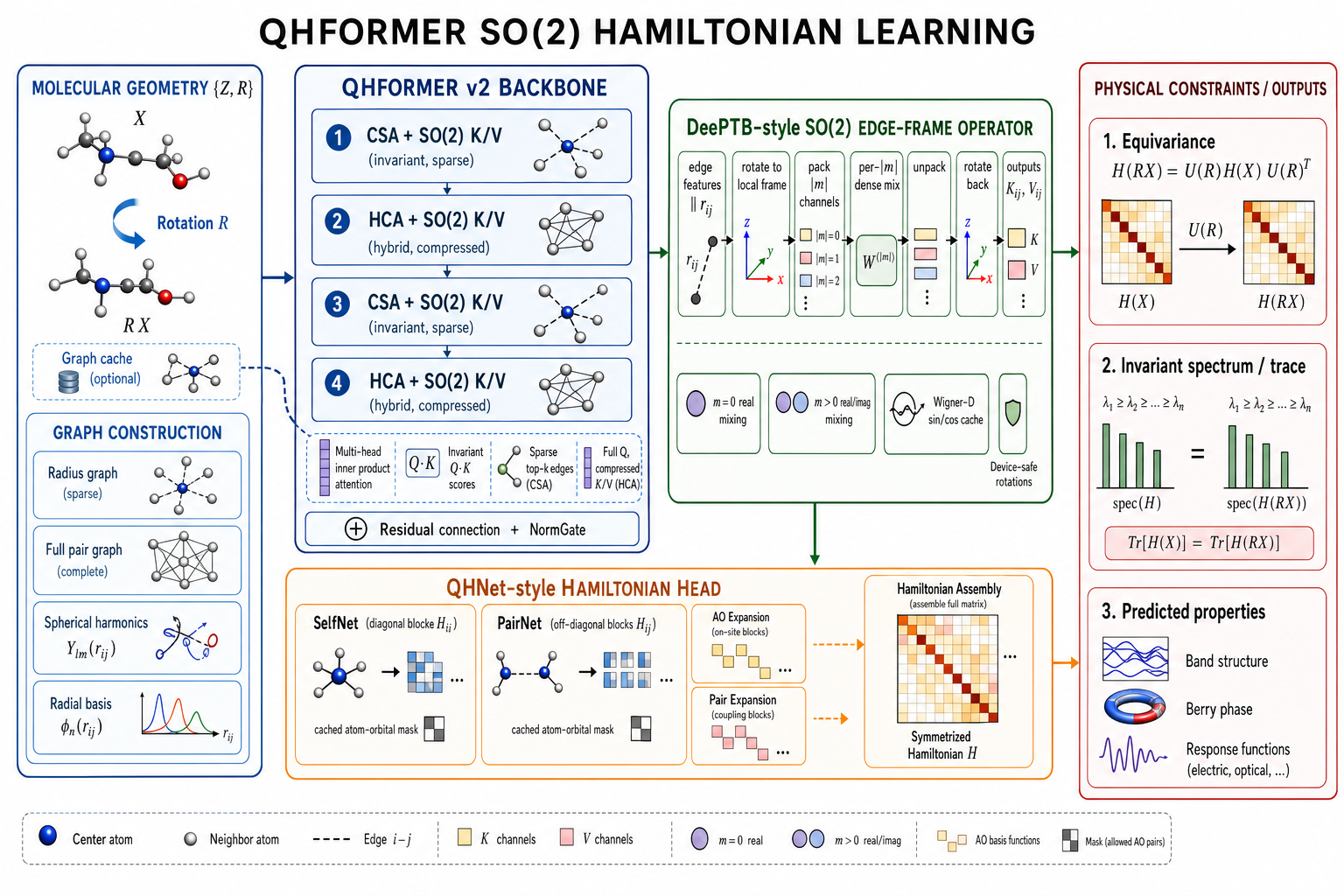
SO(3)-Equivariant Hamiltonian Prediction with Hybrid Attention - A novel neural network for quantum chemistry

An SO(3)-equivariant graph network that predicts Hamiltonian matrices from geometry, bypassing the SCF solve.

Python MIT license ★ 0 Updated May 2026
attention-mechanismequivariant-networkgraph-neural-networksquantum-chemistry
Equivariant message passing to Hamiltonian blocks
Features, implementation & modules

Key features

  • Inner-product attention keeps full irreps, so scores are exactly rotation-invariant.
  • Hybrid CSA/HCA attention with half-edge Hamiltonian assembly (v2).
  • Optional SO(2) edge-frame K/V projections for sparsity.

Implementation

PyTorch with e3nn and PyTorch Geometric; tensor products with spherical harmonics, then attention within each irrep.

Modules

  • models/equivariant attention and Hamiltonian head
  • training/training entry point and CLI
  • utils/dataset loading

Architectures live on branches: main, qhformer-v2, qhformer_v2_sparsity.

🧠 3D Model Architecture Graph

OPTXC

Optimization of Exchange-Correlation Functionals in LR-TDDFT calculations

Learns per-molecule shifts of range-separated hybrid parameters so TDDFT excitation energies match reference.

Jupyter Notebook ★ 0 Updated May 2026
density-functional-theorymachine-learningquantum-chemistrytime-dependent
Features, implementation & modules

Key features

  • SMILES to 3D structures and quantum-chemistry descriptors.
  • Stacking ensembles for LC-wPBE and wB97XD.
  • Batch Gaussian/SLURM jobs and a TADF example.

Implementation

A Python CLI (optxc input.inp) driving SLURM descriptor jobs; base learners are combined by a stacking model.

Modules

  • xyz_maker · descriptors_makerSMILES to QM descriptors
  • sbinCLI and pretrained models
  • SGM_*stacking-model training per functional